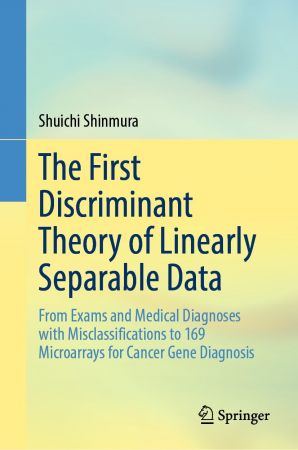
The First Discriminant Theory of Linearly Separable Data
English | 2024 | ISBN : 978-981-99-9420-5 | 373 pages| Epub PDF (True) | 63 MB
This book deals with the first discriminant theory of linearly separable data (LSD), Theory3, based on the four ordinary LSD of Theory1 and 169 microarrays (LSD) of Theory2. Furthermore, you can quickly analyze the medical data with the misclassified patients which is the true purpose of diagnoses. Author developed RIP (Optimal-linear discriminant function finding the combinatorial optimal solution) as Theory1 in decades ago, that found the minimum misclassifications. RIP discriminated 63 (=26−1) models of Swiss banknote (200*6) and found the minimum LSD: basic gene set (BGS).
In Theory2, RIP discriminated Shipp microarray (77*7129) which was LSD and had only 32 nonzero coefficients (first Small Matryoshka; SM1). Because RIP discriminated another 7,097 genes and found SM2, the author developed the Matryoshka feature selection Method 2 (Program 3), that splits microarray into many SMs. Program4 can split microarray into many BGSs. Then, the wide columnLSD (Revolution-0), such as microarray (n
We need your support!
Make a donation to help us stay online

Bitcoin (BTC)
bc1q08g9d22cxkawsjlf8etuek2pc9n2a3hs4cdrld

Bitcoin Cash (BCH)
qqvwexzhvgauxq2apgc4j0ewvcak6hh6lsnzmvtkem

Ethereum (ETH)
0xb55513D2c91A6e3c497621644ec99e206CDaf239

Litecoin (LTC)
ltc1qt6g2trfv9tjs4qj68sqc4uf0ukvc9jpnsyt59u

USDT (ERC20)
0xb55513D2c91A6e3c497621644ec99e206CDaf239

USDT (TRC20)
TYdPNrz7v1P9riWBWZ317oBgJueheGjATm