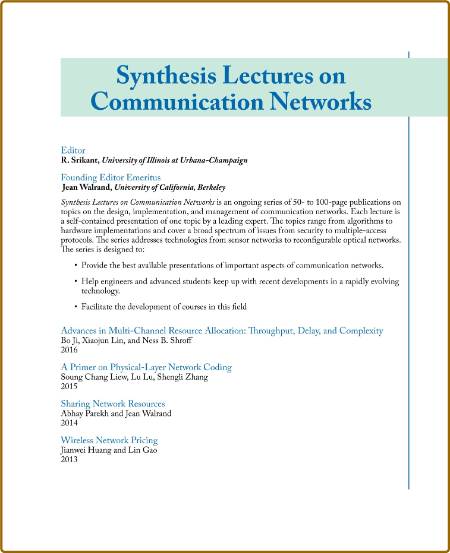
pdf | 1 MB | English | Isbn: 978-3031792717 | Author: Bo Ji | Year: 2016
Description:
The last decade has seen an unprecedented growth in the demand for wireless services. These services are fueled by applications that often require not only high data rates, but also very low latency to function as desired. However, as wireless networks grow and support increasingly large numbers of users, these control algorithms must also incur only low complexity in order to be implemented in practice. Therefore, there is a pressing need to develop wireless control algorithms that can achieve both high throughput and low delay, but with low-complexity operations. While these three performance metrics, i.e., throughput, delay, and complexity, are widely acknowledged as being among the most important for modern wireless networks, existing approaches often have had to sacrifice a subset of them in order to optimize the others, leading to wireless resource allocation algorithms that either suffer poor performance or are difficult to implement. In contrast, the recent results presented in this book demonstrate that, by cleverly taking advantage of multiple physical or virtual channels, one can develop new low-complexity algorithms that attain both provably high throughput and provably low delay. The book covers both the intra-cell and network-wide settings. In each case, after the pitfalls of existing approaches are examined, new systematic methodologies are provided to develop algorithms that perform provably well in all three dimensions.
We need your support!
Make a donation to help us stay online

Bitcoin (BTC)
bc1q08g9d22cxkawsjlf8etuek2pc9n2a3hs4cdrld

Bitcoin Cash (BCH)
qqvwexzhvgauxq2apgc4j0ewvcak6hh6lsnzmvtkem

Ethereum (ETH)
0xb55513D2c91A6e3c497621644ec99e206CDaf239

Litecoin (LTC)
ltc1qt6g2trfv9tjs4qj68sqc4uf0ukvc9jpnsyt59u

USDT (ERC20)
0xb55513D2c91A6e3c497621644ec99e206CDaf239

USDT (TRC20)
TYdPNrz7v1P9riWBWZ317oBgJueheGjATm