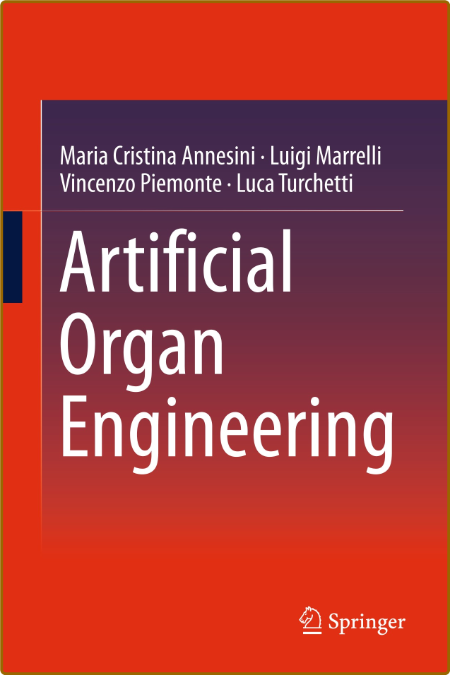
pdf | 6.68 MB | English | Isbn: B01IQP3DM2 | Author: Maria Cristina Annesini | Year: 2016
Description:
Artificial organs may be considered as small-scale process plants, in which heat, mass and momentum transfer operations and, possibly, chemical transformations are carried out. This book proposes a novel analysis of artificial organs based on the typical bottom-up approach used in process engineering. Starting from a description of the fundamental physico-chemical phenomena involved in the process, the whole system is rebuilt as an interconnected ensemble of elemental unit operations.
Each artificial organ is presented with a short introduction provided by expert clinicians. Devices commonly used in clinical practice are reviewed and their performance is assessed and compared by using a mathematical model based approach. Whilst mathematical modelling is a fundamental tool for quantitative descriptions of clinical devices, models are kept simple to remain focused on the essential features of each process.
Postgraduate students and researchers in the field of chemical and biomedical engineering will find that this book provides a novel and useful tool for the analysis of existing devices and, possibly, the design of new ones. This approach will also be useful for medical researchers who want to get a deeper insight into the basic working principles of artificial organs.
Category:Biophysics, Biochemistry, Molecular Biology
Download from RapidGator
Download from NitroFlare
We need your support!
Make a donation to help us stay online

Bitcoin (BTC)
bc1q08g9d22cxkawsjlf8etuek2pc9n2a3hs4cdrld

Bitcoin Cash (BCH)
qqvwexzhvgauxq2apgc4j0ewvcak6hh6lsnzmvtkem

Ethereum (ETH)
0xb55513D2c91A6e3c497621644ec99e206CDaf239

Litecoin (LTC)
ltc1qt6g2trfv9tjs4qj68sqc4uf0ukvc9jpnsyt59u

USDT (ERC20)
0xb55513D2c91A6e3c497621644ec99e206CDaf239

USDT (TRC20)
TYdPNrz7v1P9riWBWZ317oBgJueheGjATm